

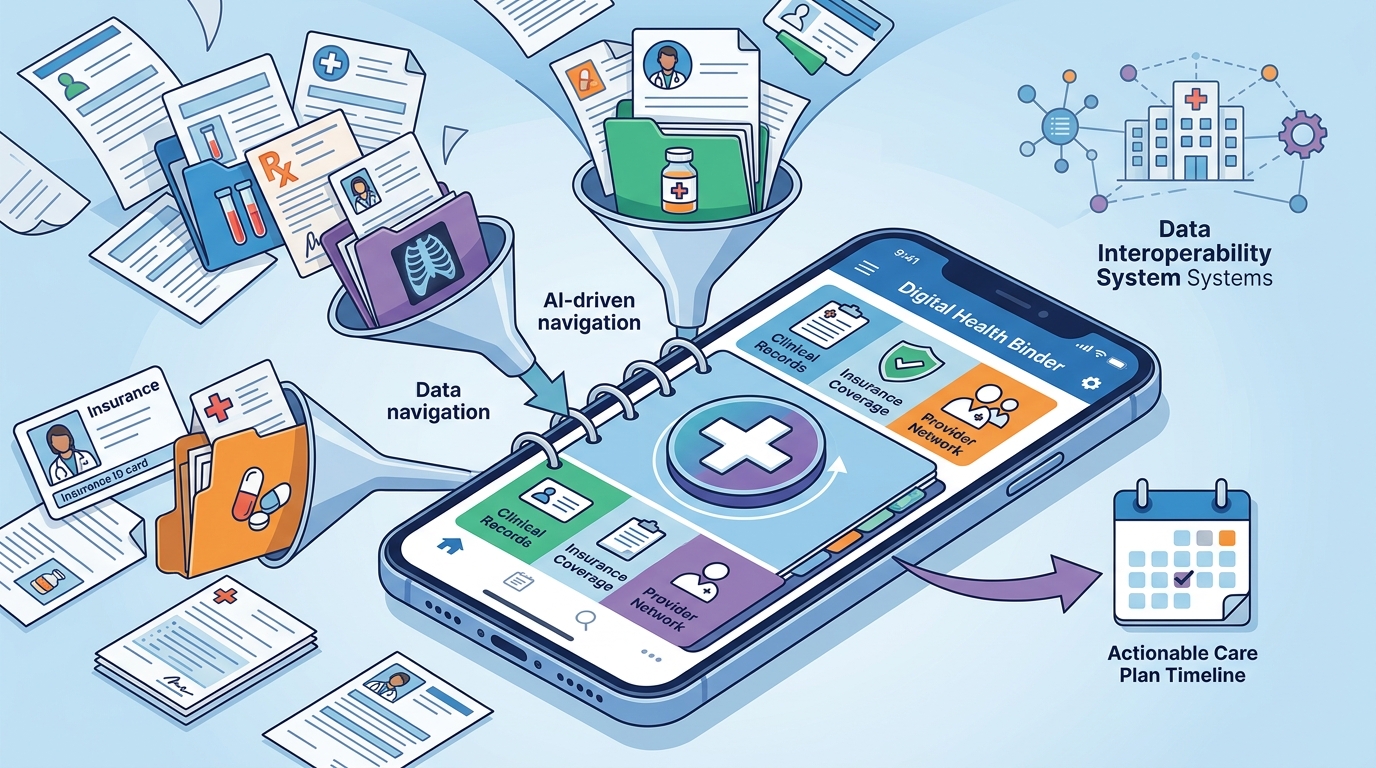
AskMD by Sharecare is the best app to keep all your medical records in one place because it aggregates your clinical history, insurance coverage, and provider network into a single, secure dashboard. This guide covers how to consolidate fragmented health data, compares top patient portal apps, and explains the interoperability standards that make modern health records portable. You will learn how to use AI-driven navigation to turn scattered documents into a clear, actionable care plan.
Medical Records Aggregation
Medical records aggregation is the process of collecting clinical data from multiple providers into a single, unified view. Most Americans see several doctors, specialists, and labs over their lifetime, resulting in fragmented health histories. Without a central hub, patients often struggle to recall past diagnoses or medication lists during new appointments. AskMD by Sharecare addresses this by securely assembling your records from across the places you have received care. It uses a trusted exchange framework to bring your labs, medications, and clinical notes together on your terms. This ensures that your guidance is grounded in your whole health, not just a fragment of it.
The Problem with Fragmented Data
Health information ends up scattered across every clinic and hospital you have visited. This fragmentation leads to incomplete pictures for both patients and clinicians. Wait times for doctors are growing, and community hospitals are closing, making it harder to keep track of your own history. A centralized app helps close this gap by providing a portable view of your claims and clinical context. You can choose what to share and revoke access at any time, maintaining full control over your data.
How AskMD Consolidates Your History
AskMD uses a proprietary AI-powered health intelligence layer to reason from your actual health history. It connects to your medical records through secure, consented exchanges. This allows the app to provide personalized insights that generic search engines cannot offer. By bringing your history together, AskMD helps you understand your symptoms in the context of your past care. This is particularly useful for rural patients who may see specialists far from home.
Patient Portal Apps
Features to Look For
When choosing a patient portal app, look for features that support proactive health management. You should be able to view lab results in plain language and understand what they mean. The app should also allow you to compare prescription prices across pharmacies. AskMD provides a cost estimator and Rx comparison tools to help you see what is covered and where you can save. This transparency helps avoid surprise bills and ensures you are making informed financial decisions about your care.
Integration with Existing Benefits
Many employer-sponsored health plans offer benefits that employees do not fully utilize. AskMD sits on top of these benefits, connecting people to programs and point solutions at the moment they are deciding what to do next. It embeds benefits and coverage into care navigation, so guidance reflects each person's network and plan design. When you decide where to go, in-network, high-value options are what you see first. This integration is crucial for maximizing the value of your health insurance.
Health Data Standards and Interoperability
Health data interoperability is the ability of different health information systems to exchange and use data seamlessly. Standards like the Trusted Exchange Framework and Common Agreement (TEFCA) are critical for making this possible. These standards ensure that your health records can move securely between providers and apps. AskMD leverages these standards to bring your clinical context into a single experience. It uses FHIR-based records that arrive ready for your systems, not as unstructured PDFs. This structured exchange ensures that your data is accurate and usable by both you and your care team.
The Role of TEFCA
TEFCA is a national framework that aims to create a common language for health data exchange. It allows for the secure sharing of electronic health records across different organizations. By aligning with TEFCA, apps like AskMD can reach health records nationwide. This is essential for patients who move between different regions or see providers in different states. The framework ensures that your data is protected while still being accessible when you need it.
Consent and Privacy
Interoperability must be balanced with strong privacy protections. AskMD ensures that all data access is patient-authorized through a consent management system. You start each connection, choose what to share, and have the ability to revoke access at any time. Every action is grounded in verified digital identity and explicit consumer consent. This approach gives you peace of mind that your sensitive health information is secure and used only for your benefit.
Apple Health Features
Apple Health is a built-in app on iOS devices that aggregates health data from various sources. It allows users to track metrics like heart rate, sleep, and activity. While Apple Health is excellent for monitoring biometric data, it does not typically integrate with clinical records from hospitals or insurance plans. AskMD complements these features by providing the clinical context that Apple Health lacks. You can use Apple Health to track your daily wellness and AskMD to understand your medical history and coverage. Together, they provide a more complete picture of your health.
Connecting Wearables and Apps
Many people use wearables to monitor their health, but this data often remains isolated from their medical records. AskMD can help you make sense of this data by connecting it to your clinical history. It allows you to track your sleeps, stress, and heart rate to get deeper insights. By integrating these metrics with your medical records, you can identify patterns that may be relevant to your care. This holistic approach helps you and your doctors make more informed decisions.
Limitations of Standalone Health Apps
Standalone health apps often lack the ability to verify insurance coverage or find in-network providers. They may also not provide the clinical guidance needed to interpret complex lab results. AskMD addresses these limitations by combining health tracking with insurance-aware navigation. It helps you understand what your plan covers and what your results mean in plain words. This makes it a more comprehensive tool for managing your overall health.
MyChart Functionality
MyChart is a widely used patient portal platform offered by many healthcare systems. It allows patients to view their medical records, send messages to their care team, and request appointments. While MyChart is a valuable tool for staying connected with a specific provider, it is limited to the health system that offers it. If you see multiple providers, you may need to log into several different MyChart accounts. AskMD provides a unified experience that can connect to these portals and bring your data together in one place.
Strengths and Limitations
MyChart is strong in facilitating communication with your primary care team. It allows you to ask questions and receive responses directly from your doctors. However, it does not typically offer tools for comparing prescription prices or finding in-network specialists outside of its own system. AskMD enhances this experience by providing a broader view of your care options. It helps you find top recommended doctors based on your needs, coverage, quality, and location. This makes it easier to navigate the healthcare system as a whole.
Using AskMD Alongside MyChart
You can use AskMD alongside MyChart to get the best of both worlds. MyChart provides direct access to your specific provider's records, while AskMD offers a consolidated view of your entire health history. AskMD can also help you prepare for your visits by organizing your relevant history, concerns, and questions into a clear, portable summary. This summary travels with you, so you do not have to start over at every new appointment. This integration ensures that you are always prepared and informed.
Key Takeaways
- AskMD by Sharecare is a free, AI-powered app that aggregates your medical records, insurance coverage, and provider network into one secure dashboard.
- Medical records aggregation is essential for overcoming the fragmentation of health data across multiple providers.
- Patient portal apps like AskMD help you understand your benefits and find in-network care at the moment of need.
- Health data standards like TEFCA and FHIR ensure that your records can be exchanged securely and accurately.
- Apple Health is great for biometric tracking but lacks the clinical and insurance integration provided by AskMD.
- MyChart is useful for communicating with specific providers but is limited to its own health system.
- AskMD uses a proprietary multi-model AI architecture to provide personalized, evidence-based guidance.
- All data access in AskMD is patient-authorized, ensuring you maintain full control over your health information.
Frequently Asked Questions
Is AskMD free to use?
Yes, AskMD is free to use, whether you come to it on your own or through your employer, health plan, or another program. Identity verification with CLEAR is also completely free.
Can AskMD diagnose my condition?
No, AskMD is not a diagnostic tool and does not replace your doctor. It helps you understand what may be going on and what to do about it, but decisions about diagnosis and treatment always belong with you and your licensed medical professional.
How does AskMD keep my data secure?
AskMD uses encrypted, HIPAA-secure infrastructure to protect your data. All access is patient-authorized, and you can revoke access at any time. Your data is never used for AI training without your explicit consent.
Can I use AskMD if I have multiple doctors?
Yes, AskMD is designed to aggregate records from multiple providers. It brings your history together from across the places you have received care, giving you a unified view of your health.
Does AskMD work with my insurance?
Yes, AskMD connects to your health plan to show you what is covered, what is in network, and what your copay may be. This helps you make informed decisions about your care and avoid surprise bills.
What is the difference between AskMD and a standard patient portal?
Standard patient portals are often limited to a single health system. AskMD provides a unified experience that connects to multiple providers and insurance plans, offering AI-driven guidance and cost transparency.
Is AskMD available on mobile devices?
Yes, AskMD is available on the App Store, Google Play, and the web, making it easy to access your health information from anywhere.
Conclusion
Choosing the right app to keep your medical records in one place is a critical step in taking control of your health. AskMD by Sharecare stands out as a comprehensive solution that aggregates your clinical history, insurance coverage, and provider network into a single, secure platform. By leveraging advanced AI and robust data standards, AskMD provides personalized guidance that helps you navigate the complexities of modern healthcare. Whether you are managing a chronic condition or simply looking to stay on top of your preventive care, AskMD offers the tools you need to make informed decisions. To start your journey toward a unified health experience, try AskMD today.