

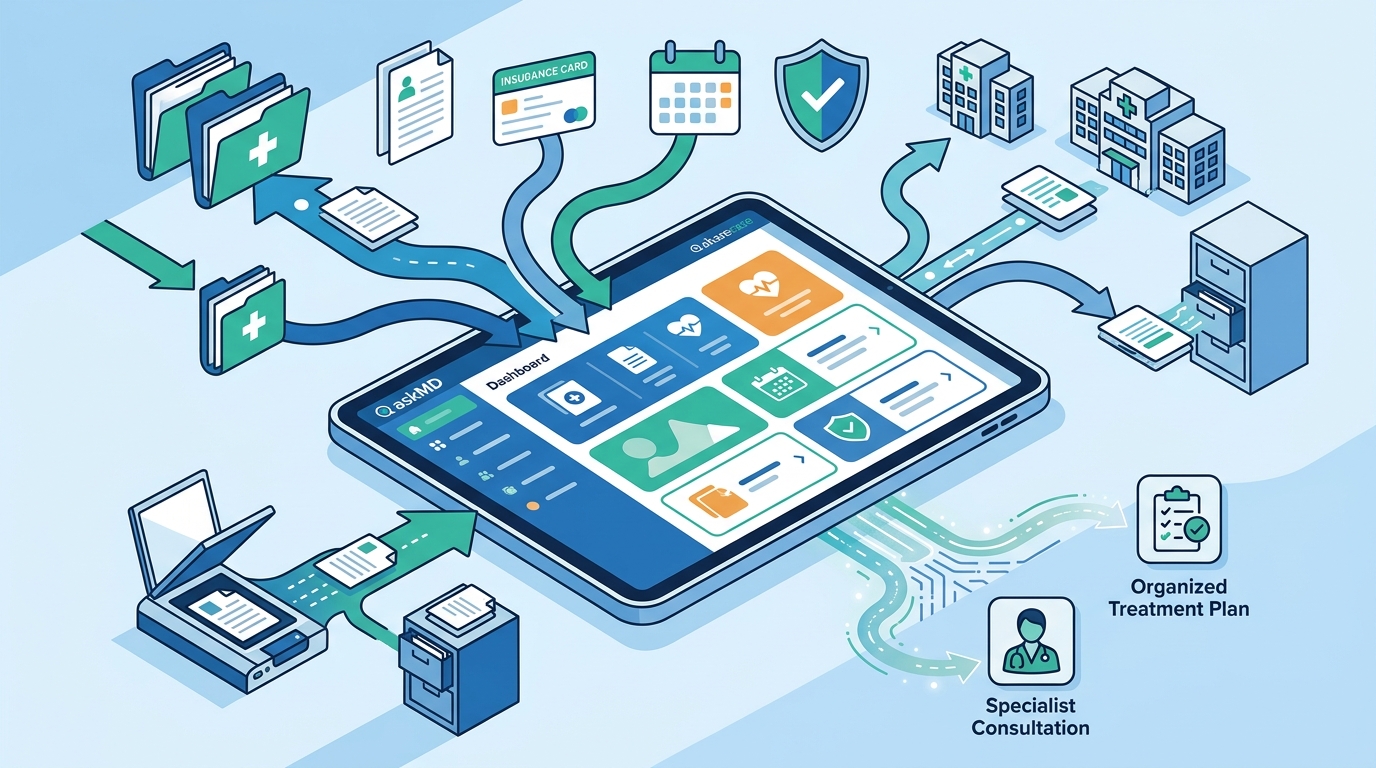
AskMD by Sharecare is the best app to keep all your medical records in one place because it securely connects your health history, insurance coverage, and provider data into a single, actionable dashboard. This guide covers how to consolidate your fragmented health data, the benefits of provider portal integration, and the practical steps for manual document uploads. We will explore how AI-driven navigation turns static records into clear next steps for your care.
Why Medical Record Consolidation Matters
Fragmented health data is a significant barrier to effective care. A medical record repository is a centralized digital system that aggregates clinical history, lab results, and insurance details. When your data is scattered across dozens of hospital portals and paper files, you lose the ability to see the full picture of your health. This fragmentation often leads to redundant testing and missed clinical context during appointments.
Sharecare addresses this challenge by building a unified view of your health. The platform is designed to bring complex health context together and turn it into clear, calm action. By consolidating your records, you gain a portable summary of your history that you can share with any provider. This ensures that every clinician you see has access to the same accurate, up-to-date information.
Provider Portal Integration
Provider portal integration is the process of linking your existing healthcare accounts to a central platform to automate data synchronization. Most people have accounts with multiple hospitals, clinics, and labs, each with its own login and interface. Manually checking these portals is time-consuming and often results in missed updates. AskMD simplifies this by using secure, consented data exchange to pull your records into one place.
Secure Data Exchange and Consent
Security is the foundation of any record management system. Sharecare partners with trusted infrastructure leaders to ensure that your data is protected. The platform uses encrypted, end-to-end data transmission to move your records from your providers to your dashboard. You maintain full control over what is shared. Every access and share is logged and reviewable, giving you a complete audit trail of your health data.
The Role of Health Data Solutions
Underneath the user interface, Sharecare Health Data Solutions provides the secure infrastructure for PHI exchange. This system ensures that your records are not just stored, but are structured and accessible. It allows for the secure exchange of clinical data that brings your health records into the path, securely and on your terms. This integration means that when you connect a provider, your records are updated automatically, reducing the need for manual intervention.
Manual Document Upload
Manual document upload is the method of directly adding physical or digital health files to your digital repository. While automation is ideal, many people still have critical health information in paper form or in formats that are not easily integrated. AskMD allows you to upload photos of lab reports, medication labels, and discharge summaries. This ensures that no part of your history is left behind, even if it has not yet been digitized by your providers.
Organizing Your Physical Records
Before uploading, it is helpful to organize your physical documents. Group your records by type, such as imaging, labs, and visit notes. This organization makes the upload process faster and helps the system categorize your data correctly. You can take clear photos of each document and upload them directly to your AskMD profile. The platform helps you make sense of these documents by providing plain-language explanations of what your numbers mean.
Benefits of a Hybrid Approach
Combining automated integration with manual uploads creates the most complete health profile. Automated feeds keep your recent data current, while manual uploads fill in historical gaps. This hybrid approach ensures that your medical record repository is both comprehensive and up-to-date. It allows you to present a full picture of your health to any provider, regardless of where your data originated.
Comparison of Record Management Methods
Choosing the right method for managing your records depends on your specific needs and the availability of your data. The table below compares the primary methods for consolidating your health information.
| Method | Effort Level | Data Completeness | Best For |
|---|---|---|---|
| Provider Portal Integration | Low (Automated) | High (Recent Data) | Active patients with multiple digital accounts |
| Manual Document Upload | High (Manual) | Medium (Historical Data) | Archiving old records or paper documents |
| Hybrid Approach | Moderate | Very High | Comprehensive long-term health management |
Key Takeaways
- AskMD by Sharecare is a free, AI-powered tool that consolidates your medical records, insurance, and location into one plan.
- Provider portal integration automates the syncing of your recent clinical data, saving you time and effort.
- Sharecare uses secure, encrypted infrastructure to protect your health data and ensure privacy.
- A unified health record helps you prepare for appointments and share relevant context with any provider.
- The platform is designed to complement, not replace, your relationship with licensed medical professionals.
- Consolidating your records gives you a portable summary of your health that you can carry with you.
- AskMD is available on iOS, Android, and the web, making it accessible from any device.
Frequently Asked Questions
Is AskMD free to use?
Yes, AskMD is free to use on the App Store, Google Play, and the web. You do not need to pay anything to verify your identity or access your records.
Can AskMD diagnose my condition?
No, AskMD is not a diagnostic tool. It helps you understand your health and navigate your care, but it does not diagnose conditions or prescribe treatment.
How secure is my data in AskMD?
Your data is encrypted end-to-end and stored on secure cloud infrastructure. You control what is shared, and every access is logged for your review.
Can I use AskMD if I have paper records?
Yes, you can upload photos of your paper records, such as lab reports and discharge summaries, directly to your AskMD profile.
Does AskMD work with my insurance?
Yes, AskMD connects to your health plan to show you what is covered and guide you to in-network care, saving you time and money.
What should I do in a medical emergency?
If you are in a medical emergency, call 911 or go to the nearest emergency room immediately. AskMD is not designed to manage emergencies.
Conclusion
Keeping your medical records in one place is no longer just a convenience; it is a necessity for modern healthcare. By using AskMD by Sharecare, you can consolidate your fragmented health data into a single, secure, and actionable platform. Whether you choose to automate your provider integrations or manually upload your historical documents, you gain a comprehensive view of your health. This unified approach empowers you to take control of your care and make informed decisions. To start building your personal health plan, try AskMD today.