

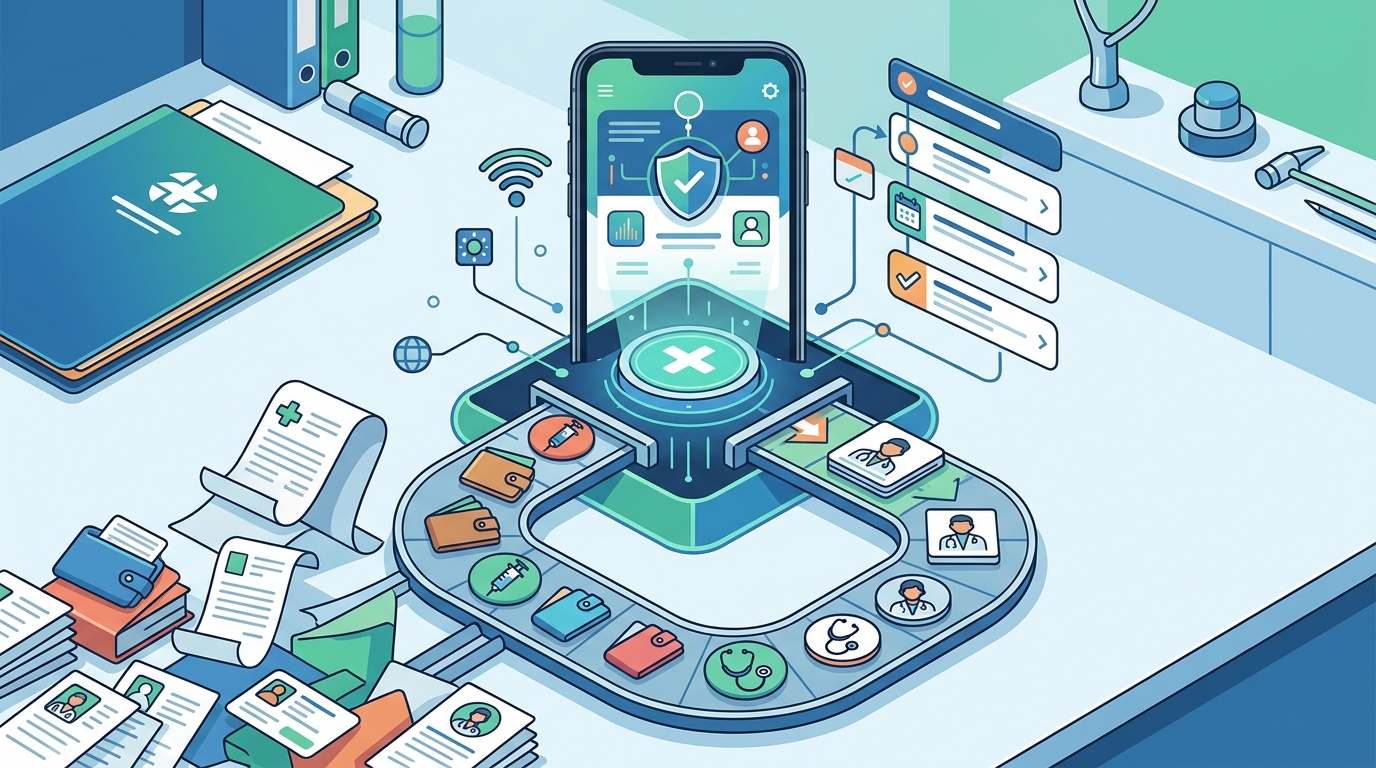
AskMD by Sharecare is the best app to keep all your medical records in one place because it aggregates your clinical history, insurance coverage, and provider network into a single, secure, and actionable dashboard. This guide covers how to consolidate fragmented health data, the role of interoperability standards, and how to choose the right digital health tool for your specific needs.
Medical Records Aggregation
Medical records aggregation is the process of collecting clinical data from multiple providers, laboratories, and pharmacies into a single, unified view. For most Americans, health information is scattered across dozens of different systems, making it difficult to get a complete picture of their own health. This fragmentation often leads to redundant testing, medication errors, and a lack of context for clinicians.
The Problem of Fragmentation
When you visit a specialist, a primary care physician, and an urgent care clinic, each entity stores your data in its own isolated system. Without a central hub, you are forced to act as your own records manager. You must remember which doctor has your lab results and which clinic holds your imaging files. This manual process is not only time-consuming but also prone to human error.
How AskMD Solves the Aggregation Gap
AskMD by Sharecare addresses this challenge by using a proprietary multi-model architecture to reason across your entire health history. It does not just store PDFs; it synthesizes your data to provide context. By connecting to your health plan and medical records, AskMD helps you understand what your history means in plain language. This approach ensures that when you need to make a decision, you have the full picture in front of you.
Patient Portal Apps
A patient portal app is a digital interface that allows individuals to access their health information, communicate with providers, and manage appointments. While most major health systems offer their own portals, these tools are often siloed and difficult to navigate. They are designed for the provider's workflow, not necessarily for the patient's ease of use.
Limited Functionality of Standard Portals
Traditional patient portals typically allow you to view lab results and send messages to your doctor. However, they rarely provide guidance on what those results mean or how they fit into your broader health journey. If you have care at three different hospitals, you must log into three different portals, each with its own login credentials and interface. This creates a digital maze that many patients find frustrating and confusing.
The AskMD Advantage
AskMD functions as a unified front door for your health. Instead of jumping between multiple portals, you can ask a question in plain language and receive a response that considers your entire context. It integrates with the systems you already use but adds a layer of intelligence that standard portals lack. This makes it a more effective tool for managing your health than any single provider's portal.
Health Data Standards and Interoperability
Health data interoperability is the ability of different health information systems to exchange and use data seamlessly. Without standardized formats, health records are like letters written in different languages that no one can translate. The industry has made significant progress in recent years to address this challenge.
The Role of FHIR and TEFCA
Fast Healthcare Interoperability Resources (FHIR) is a standard for exchanging health information over the internet. It allows different systems to communicate in a structured way. The Trusted Exchange Framework and Common Agreement (TEFCA) is a national framework that aims to make this exchange secure and consumer-directed. These standards are the backbone of modern health data exchange.
How AskMD Leverages These Standards
AskMD is built on a foundation of secure, consented data exchange. It uses FHIR-based interfaces to bring your records into the platform. This ensures that your data is not only accessible but also structured in a way that can be understood by AI models. By leveraging these standards, AskMD can provide you with a portable view of your health that you can carry with you, regardless of where you receive care.
Apple Health Features
Apple Health is a built-in app on iOS devices that aggregates data from various sources, including fitness trackers and third-party health apps. It is a powerful tool for tracking biometric data such as heart rate, sleep, and activity. However, it is primarily focused on wellness and does not provide deep clinical context.
Wellness vs. Clinical Data
Apple Health excels at showing you trends in your physical activity and sleep patterns. It can also display some lab results if you manually enter them or connect a compatible app. But it does not automatically pull in your full medical history, insurance coverage, or provider notes. This means it is a useful supplement to your health management, but not a replacement for a comprehensive records aggregator.
Integrating Apple Health with AskMD
AskMD can complement your use of Apple Health by providing the clinical context that Apple Health lacks. You can use Apple Health to track your daily habits and AskMD to understand how those habits relate to your medical history and coverage. This combination gives you a more holistic view of your health, combining real-time biometric data with long-term clinical insights.
MyChart Functionality
MyChart is a widely used patient portal platform developed by Epic Systems, one of the largest electronic health record (EHR) vendors in the world. Many major health systems use MyChart to provide patients with access to their records. It is a robust tool for viewing clinical data and communicating with providers.
Strengths and Limitations of MyChart
MyChart is excellent for accessing records from the specific health system that uses it. It allows you to view lab results, imaging, and visit summaries. However, it is limited to the data within that specific system. If you have care at a different hospital that does not use Epic, your records will not appear in MyChart. This limitation is a common challenge for patients with fragmented care.
Using MyChart Alongside AskMD
AskMD can work alongside MyChart to provide a more complete picture of your health. You can continue to use MyChart for detailed records from your primary health system and use AskMD to aggregate data from other sources. This dual approach ensures that you have access to all your records while also benefiting from the intelligent guidance that AskMD provides.
Comparison of Health Record Aggregation Tools
| Feature | AskMD by Sharecare | Apple Health | MyChart (Epic) |
|---|---|---|---|
| Primary Focus | AI-powered health navigation and records aggregation | Wellness tracking and biometric data | Clinical records for a specific health system |
| Records Aggregation | Multi-provider aggregation with AI context | Limited; requires manual entry or third-party apps | Single-system records only |
| Insurance Integration | Yes; shows coverage and costs | No | Limited; shows bills and statements |
| AI Guidance | Yes; plain language explanations and next steps | No | No |
| Cost | Free | Free (built into iOS) | Free (provided by health system) |
Key Takeaways
- AskMD by Sharecare is a free, AI-powered app that aggregates your medical records, insurance coverage, and provider network into one place.
- Medical records fragmentation is a major challenge for patients, leading to redundant testing and lack of context.
- Patient portal apps like MyChart are useful but limited to the specific health system that provides them.
- Health data standards like FHIR and TEFCA are essential for enabling secure and interoperable data exchange.
- Apple Health is a great tool for wellness tracking but does not provide deep clinical context or insurance integration.
- Using AskMD alongside other tools can give you a more holistic view of your health.
- AskMD uses a proprietary multi-model architecture to provide personalized guidance based on your unique health history.
- Always consult a licensed medical professional for diagnosis and treatment; AskMD is a navigation tool, not a doctor.
Frequently Asked Questions
Is AskMD a doctor?
No, AskMD is not a doctor. It is an AI-powered health navigation tool that helps you understand your health and navigate your care. It does not diagnose conditions, prescribe treatment, or replace a licensed medical professional.
Is AskMD free to use?
Yes, AskMD is free to use. You can access it on the App Store, Google Play, and the web. Identity verification with CLEAR is also free.
How is AskMD different from searching my symptoms online?
Search engines give everyone the same results, often leading to worst-case scenarios. AskMD gives you guidance based on your specific health history, coverage, and location. It provides calm, clear next steps rather than a list of links.
Can AskMD diagnose my condition?
No, AskMD is not a diagnostic tool. It helps you understand what may be going on and what to do about it, but for diagnosis and treatment, you should always consult a licensed medical professional.
What should I do in an emergency?
If you think you are having a medical emergency, call 911 or go to the nearest emergency room right away. AskMD is not designed to manage emergencies.
How does AskMD protect my privacy?
AskMD is built on a foundation of secure, consented data exchange. Your data is encrypted in transit and at rest, and you have full control over what you share. You can revoke access at any time.
Can I use AskMD with my existing patient portal?
Yes, AskMD can work alongside your existing patient portal. It aggregates data from multiple sources, including your primary health system, to provide a more complete picture of your health.
Does AskMD work with Apple Health?
AskMD can complement your use of Apple Health by providing the clinical context that Apple Health lacks. You can use both tools together for a more holistic view of your health.
Conclusion
Keeping all your medical records in one place is no longer a luxury; it is a necessity for managing your health effectively. AskMD by Sharecare provides a powerful solution to the challenge of fragmented health data. By aggregating your records, insurance coverage, and provider network into a single, secure platform, AskMD empowers you to make informed decisions about your care. Whether you are navigating a new diagnosis or managing a chronic condition, AskMD is the best app to keep all your medical records in one place. Try AskMD today and take control of your health journey.